The Origins of Human Ingenuity
Human History Report: The Origins of Human Ingenuity
The Origins of Human Ingenuity
Material and textbook found here
Course Summary and Approach
This course offers a rigorous scientific examination of the foundational contributions to human progress developed exclusively on the African continent. Currently, an estimated 99% of human history is omitted from modern Western-centric textbooks—an empirical oversight that this curriculum seeks to rectify. Our mission is to reclaim this ignored heritage and honor the 330,000-year human foothold established by our ancestors.
The tone of this course is unapologetically academic, corrective, and respectful of the bio-evolutionary necessity that drove African innovation. We move beyond outdated, unscientific prototypes of human development to explore the sophisticated origins of engineering, chemistry, and ethno-mathematics. This is not merely history; it is an analysis of the ingenious adaptations that allowed Homo sapiens to dominate the Earth.
Podcast and audio:
The Evolutionary Timeline of Human Ancestry
The genesis of the human lineage occurred six to seven million years ago within Africa. It is a biological fact that for the first four million years of hominin existence, there was no development anywhere else on the globe.
Time Period
6 - 7 Million Years Ago
Central Africa (Modern-day Chad)
Sahelanthropus
5 - 6 Million Years Ago
Eastern Africa
Ardipithecus
3 Million Years Ago
Ethiopia
Australopithecus (e.g., "Lucy")
The chronological evidence reinforces the "DNA trace-back" principle: while every human being on the planet can trace their genetic markers back to the African continent, the reverse is not true. Those whose ancestral lines never migrated out of Africa possess a genetic continuity that predates all external populations.

The First Engineers—Structural Integrity and Fire Control
Controlled Combustion (1,000,000 Years Ago)
Evidence from the "Cradle of Humankind" in South Africa demonstrates that human ancestors were manipulating fire to process environmental resources one million years ago. This was not the opportunistic use of wildfires, but the birth of thermal engineering.
Thermal Indicators: Artifacts and bones found in preserved caverns show exposure to temperatures exceeding 400°C (752°F), which are characteristic of managed campfires rather than natural grass fires.
Thermal Batteries: Ancestors utilized stones within hearths to act as "thermal batteries," retaining and radiating heat for extended periods.
Spatial Clustering: The deliberate arrangement of burnt specimens proves the intentional construction of hearths built into cavern floors.
The Kalambo Falls Discovery (476,000 Years Ago)
Discoveries in Zambia reveal the world's earliest known "notched engineering." This find proves that earlier ancestors—predating Homo sapiens—possessed the cognitive capacity for architectural planning.
Notched Engineering: A large-fruited bushwillow log features a precision-carved U-shaped notch on its underside, designed to fit over a second perpendicular log.
Interlocking Design: This load-bearing joint provided structural stability for what was likely a walkway, fishing platform, or dwelling foundation.
Significance: This discovery challenges the "nomadic" stereotype of the Stone Age, suggesting settled life and a specialized tool kit for shaping heavy timber nearly half a million years ago.
Science Spotlight: Luminescence Dating To date the wooden structures at Kalambo Falls, researchers utilized Luminescence Dating. This technology measures the last time minerals in the surrounding sand were exposed to sunlight. This is a critical tool for Paleolithic science, as carbon dating is ineffective for artifacts older than 50,000 years.
Early Chemistry—Mineral Processing and Pigment Engineering
The Olorgesailie Tradition (307,000 Years Ago)
At Olorgesailie, Kenya, early Homo sapiens engaged in a sophisticated four-step chemical engineering process to produce Red Ochre:
Selective Prospecting: High-quality "earthy" hematite was sourced through long-distance trekking (15–30 miles), showing a clear preference for high iron content.
Physical Processing: Raw minerals were rubbed against a flat stone Metate to create fine powders and pencil-like sticks with flattened facets for drawing.
Thermal Alteration (Dehydration): In a remarkable feat of early chemistry, yellow goethite was heated to 250°C–300°C. This triggered a dehydration reaction, chemically transforming the stone into vibrant red hematite.
Mixing and Binding: The resulting pigment was combined with animal fats, marrow, or plant resins to create waterproof paints and adhesives.
Continuity of Knowledge
The chemical processing used in the ancient Kemetic kingdom was not a localized invention but an industrialized continuation of this 300,000-year-old African tradition.
Shared Chemical Identity | Pigment Name | Chemical Formula | Natural Source | | :--- | :--- | :--- | | Hematite (Red) | Fe_2O_3 | Iron-rich ore / Dehydrated Goethite | | Goethite (Yellow) | Hydrated iron oxide | Yellow ochre / Limonite |
Bio-Chemical Engineering—Grains and Brain Evolution
The Ngalue Cavern Process (105,000 Years Ago)
Early humans in Mozambique developed a systematic ritual for processing wild sorghum, effectively acting as chemists to unlock calories.
Preparation: A shallow hearth was lined with stones (thermal batteries) to radiate heat.
Parching: Sorghum heads were moved constantly over hot ash to flash-heat the husks.
Hulling: Parched seeds were rubbed on a Metate (grinding slab) to crack the brittle, roasted husks.
Grinding: A rhythmic "pushing" motion with a hand-stone pulverized the seeds into flour.
Final Cooking: Flour was mixed with water to create a thick, bioavailable porridge.
The "Brain-Building" Powerhouse
The Homo sapiens brain is an "energy hog," consuming 20–25% of our basal metabolic energy. While meat provided structural building blocks, complex carbohydrates provided the high-volume glucose required for "encephalization" (brain growth).
The AMY1 Gene Adaptation: During this period of African evolution, humans underwent a genetic shift—increasing copies of the AMY1 gene. This produced higher levels of salivary amylase, the enzyme required to "unlock" the energy in starches like sorghum. Furthermore, 2019 data from Border Cavern, South Africa, confirms that ancestors were "carb-loading" with starchy plants as early as 170,000 years ago.
The "Shell Problem": Wild sorghum is fused to an indigestible woody shell. Roasting was the engineering solution, utilizing "Steam Pop" (internal pressure) and "Embrittlement" to make the grain edible.
Applied Mathematics—From Tally Sticks to Number Theory
The Lebombo Artifact (44,000 Years Ago)
Found in the Lebombo Mountains, this baboon fibula represents the first instance of data externalization. By carving 29 notches into the bone, information was stored outside the human brain. Theories suggest it was a lunar or menstrual calendar, indicating that the first mathematicians were likely women tracking biological and celestial cycles.
Matupi Cavern Microliths (40,000 Years Ago)
Microliths represent the birth of lithic technology and applied geometry.
Standardization: Engineers replicated mathematical "templates" thousands of times to ensure pieces fit composite tools.
Geometry: The use of crescents, triangles, and trapezoids was a calculated effort to improve aerodynamics and barbing.
Modular Design: This was the invention of the "interchangeable part," where a broken blade could be replaced without discarding the entire spear or saw.
Precision: These were crafted from milky quartz, an exceptionally difficult material to flake, requiring high mathematical precision.
The Ishango Artifact (20,000 - 25,000 Years Ago)
The Ishango bone is a sophisticated mathematical device featuring a sharp piece of quartz fixed to one end, serving as a writing stylus.
Column G (Center): Demonstrates multiplication and division through doubling (3 to 6, 4 to 8) and halving (10 to 5).
Column M (Right): Identifies the four prime numbers between 10 and 20 (11, 13, 17, 19).
Column Q (Left): Establishes a Base-10 or Base-20 system (groupings of 11, 21, 19, and 9).
Final Synthesis: The Nile Connection
The "gap" of over 200,000 years, during which Homo sapiens developed exclusively within Africa, provided the necessary lead time for the perfection of STEM disciplines. It is no coincidence that the Ishango Artifact was discovered at the headwaters (the source) of the Nile.
Geographical and archaeological logic suggests that this mathematical knowledge traveled downriver over millennia. This foundational logic—prime numbers, base-10 systems, and doubling/halving arithmetic—eventually empowered the Old Kingdom of Kemet to execute the architectural and engineering marvels of the Nile Valley.
Critical Thinking Question: Given that the Ishango Bone provides empirical evidence of prime numbers and base-10 systems 20,000 years ago, why does modern pedagogy continue to attribute the origins of mathematics to the Greeks of 2,000 years ago?
Images:
Acclaiming the King, ca. 1353-1336 B.C.E. Sandstone, pigment, 8 x 11 1/4 x 1 3/16 in. (20.3 x 28.6 x 3 cm). Brooklyn Museum, Charles Edwin Wilbour Fund, 64.199.1. Creative Commons-BY creativecommons.org/licenses/by/3.0
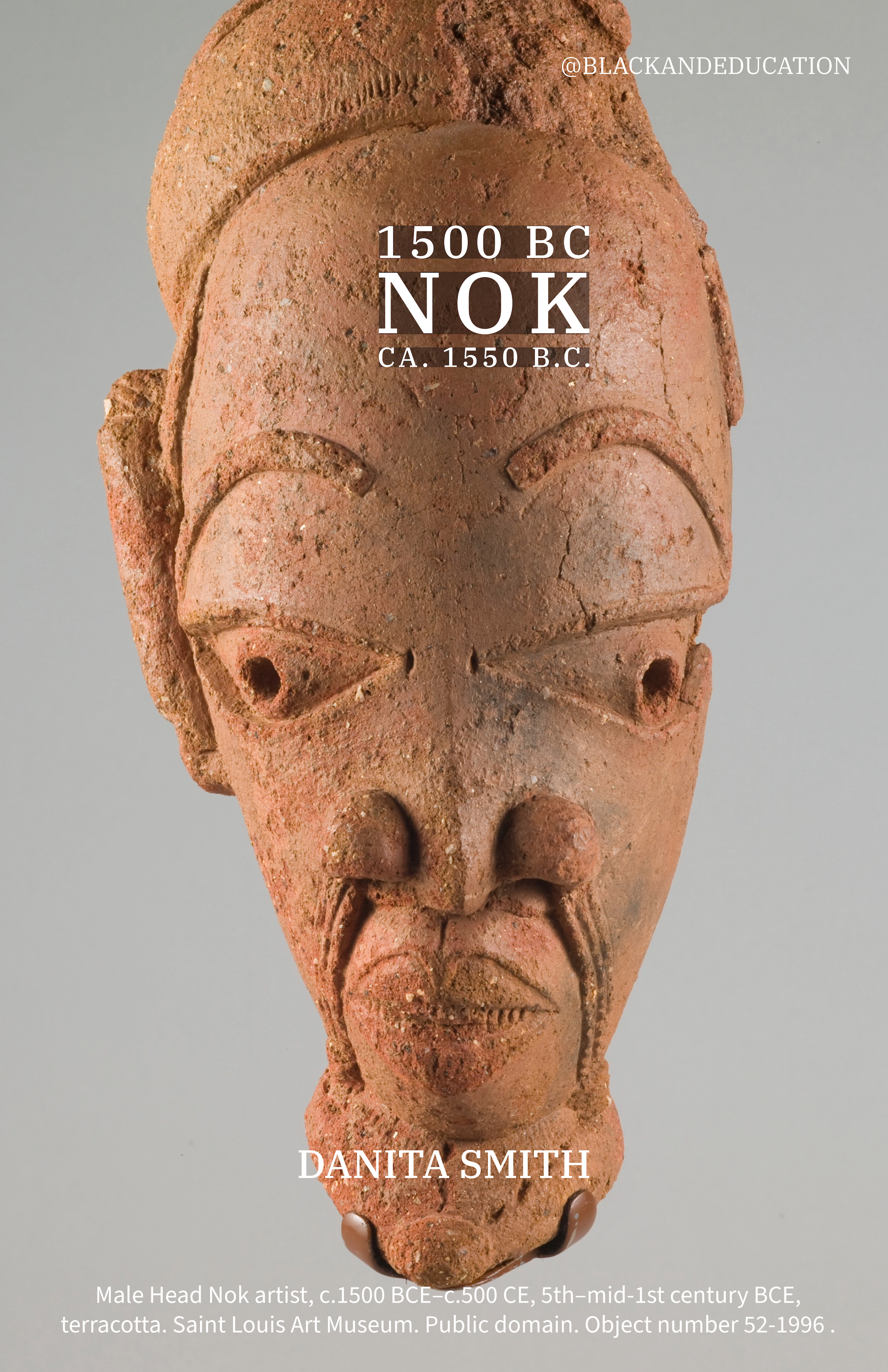
Male Head Nok artist, c.1500 BCE–c.500 CE, 5th–mid-1st century BCE, terracotta, Saint Louis Art Museum, Public domain, object number 52-1996.
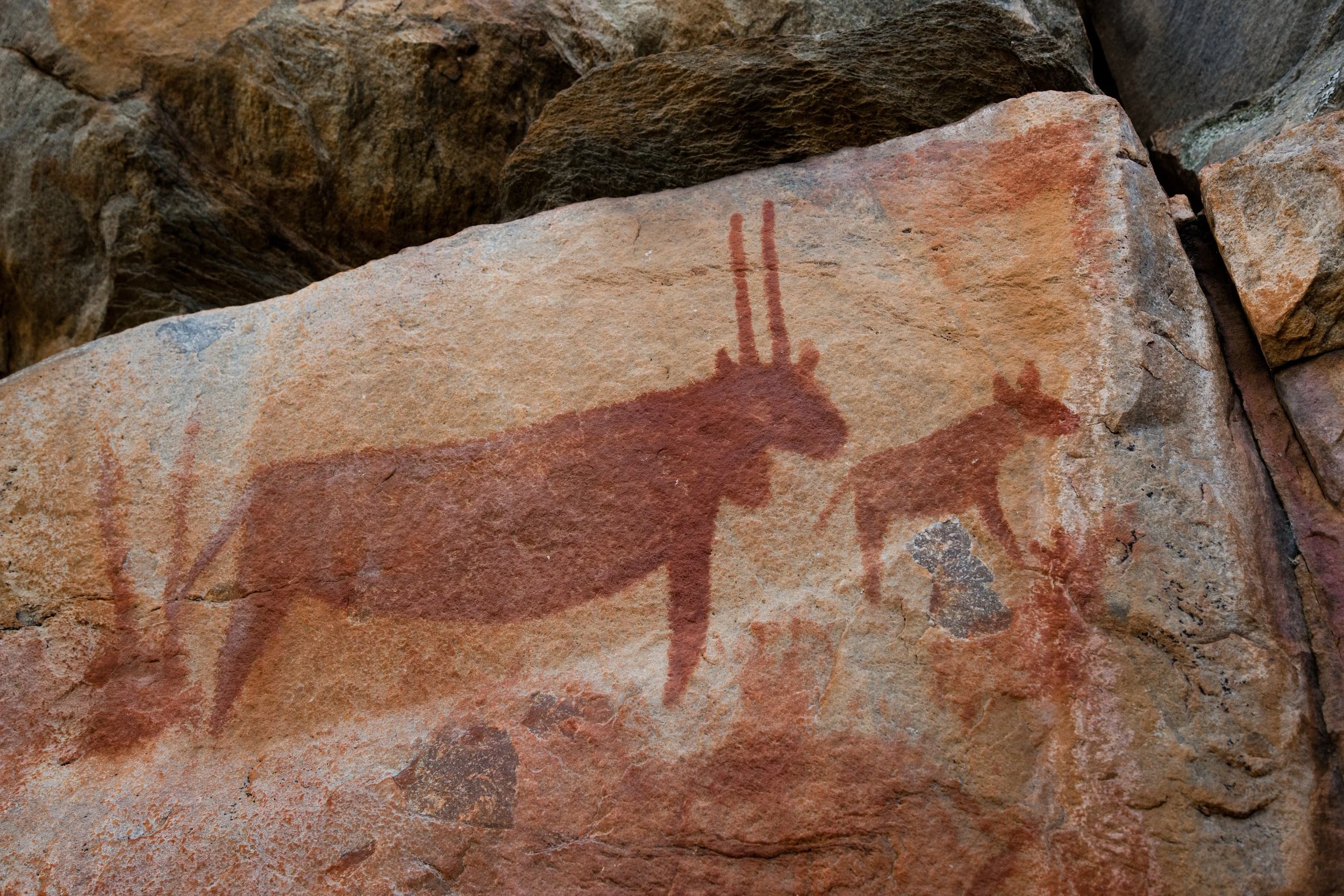
Rock art - Tsodilo Hills - Botswana from Adobe images.